Spending Less by Buying Better: The Lifetime Economics of a Durable Wardrobe
When most Americans stand at a retail rack deciding between a $15 t-shirt and a $120 one, the math feels obvious. Fifteen dollars wins. But that instinct, however understandable, is built on an incomplete equation—one that ignores the most important variable in the entire transaction: time.
The concept of cost-per-wear is not new, but it remains profoundly underutilized as a decision-making tool. When you divide the purchase price of a garment by the number of times you actually wear it, the financial hierarchy of your closet inverts in ways that may surprise even the most budget-conscious shopper.
The White T-Shirt Thought Experiment
Consider one of the most fundamental garments in American wardrobes: the white crewneck t-shirt. It is, in theory, a simple object. In practice, it serves as an ideal case study for understanding the economics of apparel quality.
Scenario A: A fast-fashion white t-shirt retails for $15. After approximately eight to ten washes, the fabric begins to thin, the neckline loses its shape, and the color shifts from crisp white to a dull gray. Conservatively, this shirt sees 20 wears before it is relegated to the rag pile or, more likely, the landfill. The cost-per-wear: $0.75.
Scenario B: A well-constructed white t-shirt, made from a heavier-weight organic cotton with reinforced seams and a preshrunk finish, retails for $120. Worn twice a week across changing seasons, this shirt holds its structure and color through consistent laundering. Over two to three years, it accumulates 200 wears with ease. The cost-per-wear: $0.60.
The more expensive shirt is, mathematically, the cheaper option. And that calculation does not yet account for the hidden costs embedded in the fast-fashion model.
The Costs That Never Appear on the Receipt
The sticker price of a garment conceals a range of expenditures that accumulate quietly over time. Understanding them reframes what "affordable" clothing actually means.
Replacement frequency. A consumer who purchases five $15 t-shirts over the course of two years—each lasting roughly four months of regular wear—has spent $75 to achieve what a single $120 shirt accomplishes. They have also spent time shopping, making decisions, and managing a higher-turnover wardrobe.
Laundering costs. Cheaper fabrics frequently require more careful handling to delay deterioration: delicate cycles, cold water washes, and air drying. Yet even with that care, they degrade faster. Higher-quality garments, by contrast, tend to be more resilient across standard wash conditions, reducing the energy and water expenditure associated with their maintenance over a longer lifespan.
Environmental overhead. The environmental cost of producing a single cotton t-shirt is estimated at approximately 700 gallons of water. When a garment is discarded after 20 wears rather than 200, that environmental investment is effectively wasted at ten times the rate. The EPA reported that Americans generated 17 million tons of textile waste in a single recent year, the vast majority of which ended up in landfills. Durable clothing does not eliminate this footprint, but it substantially reduces it per unit of use.
Opportunity cost. Every dollar spent replacing a worn-out garment is a dollar not directed toward a piece that would have served longer. Over a decade, the cumulative difference between a fast-fashion wardrobe and a quality-focused one can reach into the thousands of dollars.
Applying the Framework Across Your Wardrobe
The white t-shirt example translates across nearly every category of basic apparel.
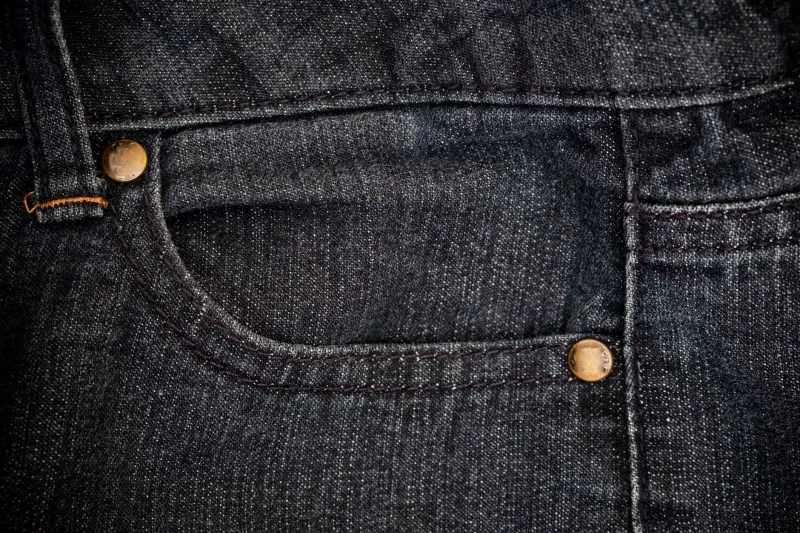
Denim. A well-constructed pair of jeans—raw selvedge or a heavy-weight denim with reinforced stress points—may cost $150 to $200. Worn 150 times over three or four years, the cost-per-wear falls to approximately $1.00 to $1.33. A $40 pair of fast-fashion jeans that fades, tears at the seams, or loses its fit after 30 wears costs $1.33 per wear—and often more, once you factor in the emotional toll of a garment that simply does not perform.
Outerwear. This category may represent the clearest argument for quality. A $400 wool overcoat worn 100 times per season across ten years accumulates 1,000 wears—a cost-per-wear of $0.40. A $90 polyester alternative that pills and loses its insulation after two winters achieves perhaps 200 wears at $0.45 per wear, while also contributing to microplastic pollution with every wash.
Footwear. Quality leather boots resoled twice over a fifteen-year lifespan offer a cost-per-wear calculation that virtually no fast-fashion alternative can approach.
The Pragmatist's Case for Conscious Consumption
It is worth stating plainly: this is not an argument rooted solely in environmental idealism. The numbers make the case independently of any ethical framework. If your goal is to spend less money on clothing over the course of your life, buying fewer, better things is the more efficient strategy.
This does not require a dramatic overhaul of spending habits overnight. The transition from a high-volume, low-quality wardrobe to a smaller, more durable one can be gradual. Begin with the categories you wear most frequently—the items that accumulate wear fastest and therefore benefit most from quality investment. A reliable white t-shirt, a well-fitted pair of dark jeans, a versatile mid-layer: these are the building blocks of a wardrobe that earns its keep.
What to Look for When Evaluating Quality
Not every expensive garment is a durable one. Price is a signal, not a guarantee. When assessing whether a piece merits investment, consider the following indicators:
- Fabric weight and composition. Heavier-weight natural fibers—dense cotton, merino wool, linen—generally outlast lighter synthetics in everyday wear conditions.
- Construction details. Reinforced seams, bar tacking at stress points, and flat-felled stitching are markers of garments built for longevity.
- Brand transparency. Companies that disclose their manufacturing processes and material sourcing are more likely to stand behind the durability of their products.
- Fit architecture. A garment cut with precision and structure holds its shape across repeated laundering better than one cut loosely to accommodate sizing variation.
The Longer View
The American consumer culture has long been oriented around novelty and volume—more options, more seasons, more turnover. That model has proven costly in ways both financial and environmental. The alternative is not austerity; it is precision. It is the recognition that a wardrobe built on fewer, better pieces serves its owner more faithfully, costs less over time, and places a smaller burden on the systems—ecological and economic—that sustain us.
The math, when calculated honestly, points in one direction. Buying well is not a luxury. It is, ultimately, the more rational choice.