Why Your Clothes Don't Fit — And What It's Really Costing You

Photo: tailor measuring suit jacket on client for alterations, via i.ytimg.com
You have almost certainly experienced this: a shirt that fits through the shoulders but pools at the waist. Trousers with the correct waist measurement that are inexplicably too short, or too long, or cut so narrowly through the thigh that they restrict movement entirely. A jacket that looks reasonable on the hanger and wrong on your body in ways that are difficult to articulate.
This is not a personal failing. It is a structural problem built into the American retail clothing industry — and it carries a real cost that most consumers never fully account for.
How Sizing Became Unreliable
The standardized sizing system used by most American clothing manufacturers has its origins in mid-twentieth-century military measurement studies. Those studies produced averages based on a relatively narrow demographic sample, and the resulting size charts were adopted wholesale by the ready-to-wear industry.
Decades later, the population those charts were built on bears little resemblance to the actual diversity of American bodies. More significantly, manufacturers have compounded the original problem through a practice known as vanity sizing — the gradual expansion of labeled measurements to make consumers feel they are wearing a smaller size than they were a generation ago. A size medium today is not the same garment it was in 1985. Neither is a size 32 trouser waist.
The result is a system in which the same labeled size varies meaningfully across brands, across product lines within a single brand, and even across different production runs of the same garment. A consumer who wears a large in one manufacturer's shirts may find themselves between sizes at another, and genuinely unable to make a standard size work at a third.
The Unworn Garment Problem
Poor fit is the primary reason clothing goes unworn. This is not a subjective observation — it is consistent with what researchers who study consumer clothing behavior have found repeatedly. When a garment does not fit well, it does not get worn, regardless of its quality, cost, or appeal at the point of purchase.
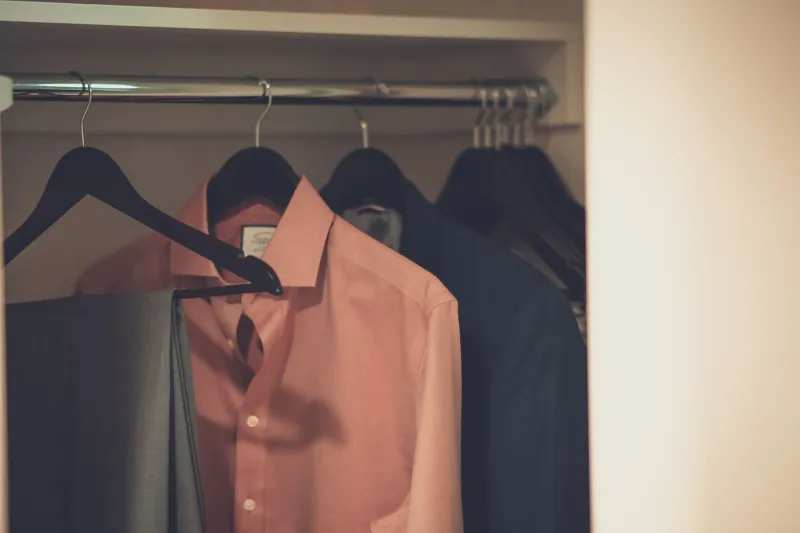
Consider what this means in practice. A consumer buys a pair of trousers. They fit reasonably in the store — or seemed to, under the particular lighting and abbreviated try-on that retail environments encourage. At home, in natural light and actual movement, the fit reveals itself as subtly wrong. The rise is too low, the seat too generous, the hem two inches too long. The trousers are not returned — the receipt has been lost, or the return window has closed, or the consumer tells themselves they will have them altered and then does not.
The trousers hang in the closet. Months pass. The consumer buys another pair.
This cycle, multiplied across a wardrobe and repeated over years, accounts for an enormous proportion of the clothing waste that conscious consumers rightly find troubling. The garments were not poorly made. They were simply never worn — because they never fit.
The True Cost of the Fit Gap
The financial implications of chronic poor fit are rarely calculated directly, but they are substantial.
Consider a consumer who purchases four or five garments per season that do not perform as expected due to fit issues. At an average price of $60 per item — modest by any measure — that represents $240 to $300 in semi-annual spending on clothing that will see limited or no use. Annualized, the figure approaches $500 to $600. Over five years, it exceeds $2,500.
Those are conservative estimates. They do not account for the higher-priced items — the dress shirts, the tailored trousers, the blazers — where fit problems are both more consequential and more common.
Now consider the alternative: a consumer who spends $30 to $60 per garment on professional alterations. A trouser hem, $15 to $25. A shirt taken in at the waist, $20 to $35. A jacket sleeve shortened, $25 to $40. These are not extravagant investments. Applied to a well-chosen garment, they transform a piece that would otherwise go unworn into one that fits the body it belongs to — and therefore gets worn, repeatedly, for years.
Alterations as a Sustainability Practice
The connection between fit and sustainability is direct and underappreciated.
A garment that fits well gets worn. A garment that gets worn justifies its production cost — the water, the energy, the labor, the materials — across every wear. A garment that does not fit sits in a closet until it is donated, discarded, or sold for a fraction of its original price, having never offset the environmental cost of its manufacture.
Investing in alterations is therefore not a luxury. It is a mechanism for extracting the full value from clothing you have already purchased — and for reducing the frequency with which you need to replace items that were never truly wrong, only improperly fitted.
This principle extends to the purchasing decision itself. A well-constructed garment in a size that can be altered down is almost always preferable to a poorly constructed one that happens to fit off the rack. Quality fabric and sound construction can be tailored to your body. Inferior materials and weak seams cannot be improved by a tailor.
The Made-to-Measure Option
For certain foundational pieces — dress shirts, suit trousers, blazers — made-to-measure represents an increasingly accessible alternative to the off-the-rack gamble.
Online made-to-measure services have expanded significantly in recent years, and while the entry-level price point remains higher than mass retail, it is not dramatically so for the categories where fit matters most. A made-to-measure dress shirt from a reputable domestic or international manufacturer typically runs between $100 and $200 — comparable to a quality off-the-rack shirt that may still require alteration.
The difference is that a made-to-measure garment is built to your specific measurements from the outset. There is no alteration required because there is no deviation to correct. The garment fits because it was designed to.
For consumers who have struggled consistently with a particular category — shirts that never sit right across the back, trousers that cannot accommodate both waist and inseam simultaneously — made-to-measure is worth the incremental cost. A single well-fitting shirt that you reach for consistently is worth more than three marginally fitting ones that you wear out of obligation.
Building a Wardrobe That Actually Fits
The practical path forward begins with honesty. Go through your current wardrobe and identify the pieces that do not fit — not the ones you hope to fit into someday, but the ones that do not fit your body as it is today. Set them aside.
Of those pieces, determine which are worth altering. A quality garment with a correctable fit issue is a candidate for the tailor. An inexpensive garment with a structural fit problem — where the proportions are simply wrong for your body — is a candidate for resale or donation.
For future purchases, establish a personal standard: nothing enters your wardrobe unless it fits, or unless you have already committed to having it altered within a specific time frame. This single rule, applied consistently, will reduce both your spending and your wardrobe waste more effectively than almost any other practice.
Fit is not a cosmetic concern. It is the foundation of a wardrobe that functions — and a wardrobe that functions is one that lasts.