Dress Once, Think Never: The Case for a Deliberate Wardrobe Routine
There is a particular kind of exhaustion that accumulates before the workday even begins. It arrives in the form of a closet stared at too long, a drawer opened and closed twice, a shirt chosen not because it was right but because the clock was already moving. For millions of Americans, the morning wardrobe decision is a small tax levied daily on attention, energy, and composure — and most of them have never stopped to question whether they need to keep paying it.
A growing number of professionals have found a different arrangement. By constructing a deliberate, limited clothing palette — one chosen with care and worn with consistency — they have effectively removed clothing decisions from their cognitive ledger. What remains is focus, clarity, and a wardrobe that does exactly what it is supposed to do.
The Science Behind the Decision
Psychologists have long studied what is commonly called decision fatigue: the measurable deterioration in decision quality that follows a series of choices, however trivial. Research conducted over the past two decades suggests that the human capacity for sound judgment is not unlimited. Each decision made, from breakfast to attire to email responses, draws from the same finite reservoir of mental energy.
Clothing choices, though they may seem inconsequential, are rarely made in isolation. They arrive alongside other morning demands — commute logistics, schedule review, family coordination — and they compound. A person who spends eight minutes deliberating over what to wear has not simply lost eight minutes. They have spent a portion of their daily cognitive capital on a problem that, with forethought, need not exist at all.
This is not a theoretical concern. Behavioral economists at institutions including the University of Minnesota and Cornell have documented the downstream effects of early-day decision accumulation on professional performance, impulse control, and creative output. The implications for wardrobe design are direct and practical.
What a Deliberate Palette Actually Looks Like
The phrase "capsule wardrobe" has been used so freely in recent years that it has lost much of its original precision. What we are describing here is something more specific: a wardrobe constructed around a limited set of well-made, coordinating pieces that can be worn in consistent rotation without requiring active thought.
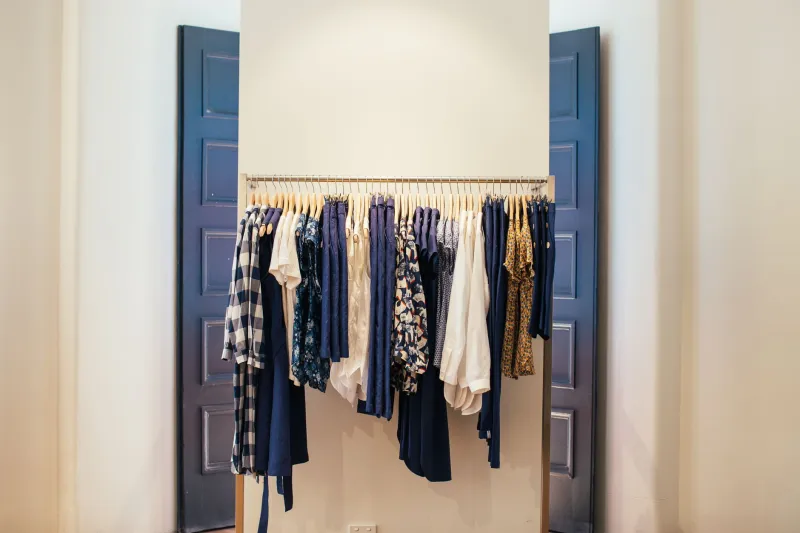
This does not mean wearing the same outfit every single day, though some professionals do precisely that and report no social consequence worth noting. It means building a system. A core palette of two or three neutral colors. A handful of versatile silhouettes in high-quality fabrics that hold their shape and resist premature wear. A set of reliable footwear that transitions across contexts. When every item in a wardrobe works with every other item, the act of getting dressed becomes procedural rather than creative — and that is, in this context, a virtue.
The professionals who adopt this approach tend to share a common observation: the wardrobe they once maintained felt like a collection of options, but functioned as a collection of obligations. Each piece demanded consideration, combination, and judgment. A smaller, more deliberate wardrobe demands none of that. It simply works.
Quality as the Foundation of Consistency
There is a critical element that separates a deliberate wardrobe from a merely sparse one: the quality of what remains. A limited wardrobe functions only when the pieces within it can withstand consistent wear without degrading in appearance or structure. Fabrics that pill after a dozen washes, seams that separate under regular use, colors that fade before a season is out — these do not support a rotation. They undermine it.
This is where investment in durable, well-constructed clothing becomes not an indulgence but a practical necessity. A shirt worn three times per week for two years must be built to that standard. It must retain its drape, its color, its integrity. Anything less forces the wearer back into a cycle of replacement, reconsideration, and renewed decision-making — the very cycle the deliberate wardrobe is designed to eliminate.
Conscious consumers have begun to recognize this logic. Spending more on fewer, better pieces is not extravagance. It is arithmetic: a sixty-dollar shirt replaced four times costs more, in money and in time, than a single well-made garment that outlasts all of them.
The Professionals Who Have Already Made the Shift
The image of the high-achieving professional in a near-identical outfit day after day has become familiar enough to border on cliché — but the underlying principle is genuine. Across industries, from technology to law to medicine to education, professionals who have streamlined their wardrobes report similar outcomes: reduced morning friction, greater consistency in how they present themselves, and a subtle but meaningful increase in the sense that their clothing is working for them rather than requiring work from them.
A corporate attorney in Chicago described the shift this way: she had spent years maintaining a wardrobe she considered sophisticated, only to realize that the breadth of her options was producing daily indecision rather than daily confidence. After rebuilding around a palette of navy, charcoal, and cream — all in fabrics she trusted — she found that getting dressed had become, in her words, "the one part of the morning that doesn't require me to be awake yet."
A high school principal in Atlanta made a similar transition after a professional development workshop on cognitive load. He reduced his wardrobe to a rotating set of well-fitted dress shirts, two pairs of trousers, and a single blazer. The response from colleagues, he noted, was not indifference — it was recognition. He became, in a quiet way, more identifiable. His consistency read as intentionality.
Dressing with Purpose, Not Performance
There is a distinction worth drawing between dressing to be seen and dressing to function. Fashion culture has long emphasized the former — the outfit as statement, as performance, as daily self-expression. There is value in that orientation, and it is not being dismissed here. But for those whose primary goal is to show up fully present and mentally available for the demands of their day, dressing to function is the more honest framework.
A deliberate wardrobe does not announce itself. It does not ask for attention. It simply places its wearer in a position of quiet readiness — appropriately dressed, consistently presented, and unburdened by the small theater of daily sartorial choice. In that quietness, there is a kind of confidence that louder wardrobes rarely achieve.
At Steadfast Apparel, we have always understood clothing as something built to serve. Not to impress, not to accumulate, but to perform reliably across the real conditions of a real life. The deliberate wardrobe is the fullest expression of that understanding: clothing chosen with care, worn with purpose, and trusted to do its job — every single morning, without being asked twice.