Twelve Months, One Wardrobe: The Case for Dressing Beyond the Season
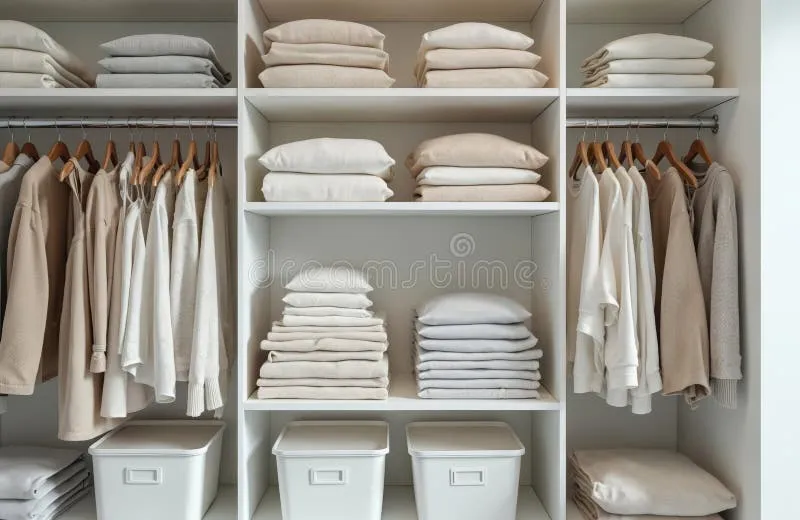
Photo: neatly organized capsule wardrobe neutral colors folded on shelves, via thumbs.dreamstime.com
Every spring and fall, a familiar ritual plays out across American households. Sweaters get boxed and stored. Linen shirts emerge from the back of the closet. By the time the next season arrives, the cycle reverses — and somewhere in the middle of each rotation, the quiet suspicion grows that this process is consuming more time, money, and space than it is worth.
That suspicion is correct.
The seasonal wardrobe switch is, in large part, a habit reinforced by an industry that profits from perpetual renewal. Fast fashion depends on consumers believing that their existing clothing has expired — that the pieces purchased six months ago are no longer adequate for the months ahead. The result is a wardrobe that is always partially wrong for the current moment and never fully satisfying.
There is a more coherent approach. It requires some initial thought and a willingness to invest in pieces selected for versatility rather than trend, but the return — a wardrobe that functions across all twelve months without constant intervention — is considerable.
The Myth of the Seasonal Wardrobe
American weather is genuinely variable, and it would be unreasonable to suggest that a single outfit serves equally well in January and July. That is not the argument. The argument is that the structure of a wardrobe — its core pieces, its organizing logic, its relationship to your daily life — need not be dismantled and rebuilt twice a year.
Most people, when they conduct an honest audit of their seasonal rotations, find significant overlap. The dark jeans worn in October are not fundamentally different from the dark jeans worn in March. The button-front shirt that works in spring works in fall. The real seasonal variation tends to involve outerwear, footwear, and layering — not the complete replacement of a foundational wardrobe.
Understanding this distinction is the first step toward building something more durable.
Choosing Fabrics That Travel Across Months
Fabric selection is the technical foundation of a year-round wardrobe. Certain materials are engineered, by nature or by design, to perform across a range of temperatures. Others are genuinely seasonal and belong in a more limited rotation.
Merino wool is the most frequently cited example, and for good reason. It regulates body temperature with unusual effectiveness, making it functional in both cool and mild conditions. A merino crewneck worn over a shirt in October can be worn alone in April. It does not require dry cleaning after every use, resists odor, and — when sourced from quality producers — develops character rather than deteriorating with wear.
Medium-weight cotton in tightly woven constructions — oxford cloth, twill, canvas — performs similarly across seasons. These fabrics breathe in summer heat and layer effectively under heavier outerwear in winter. They hold their shape, accept laundering without significant degradation, and represent some of the most durable value available in apparel.
Linen-cotton blends extend the range of pure linen, adding structure and reducing the wrinkling that makes 100% linen impractical in certain professional or social contexts. A well-constructed linen-cotton trouser can carry a wardrobe from late spring through early fall without feeling like a seasonal compromise.
Conversely, fabrics that are genuinely seasonal — heavy tweed, lightweight chiffon, thick fleece — are best treated as supplementary rather than foundational. They serve a specific temperature range and should occupy a smaller proportion of a considered wardrobe.
Building Around a Layering Logic
Layering is the practical mechanism that allows a limited set of core pieces to serve across variable conditions. The key is building layers that are genuinely interoperable — not merely pieces that happen to occupy the same closet.
A functional layering system operates in three registers. The base layer manages comfort against the skin: fitted shirts, merino underlayers, lightweight knits. The mid layer provides warmth and definition: structured sweaters, fleece-lined shirts, unlined blazers. The outer layer addresses weather: a quality wool overcoat, a waxed canvas jacket, a packable insulated layer for travel.
When each register is populated with pieces in compatible colors and complementary proportions, the combinations multiply considerably. A navy merino sweater over a white oxford shirt under a charcoal wool coat is not a specific outfit — it is a template that can be varied across dozens of days without repetition feeling like limitation.
The investment logic follows directly. A single well-made wool overcoat purchased at a quality price point will serve this outer-layer function for a decade or more. Compared to purchasing and discarding three or four lower-quality alternatives over the same period, the economics are straightforward.
Reducing Decision Fatigue Through Structure
Beyond the financial argument, a year-round wardrobe built on coherent principles dramatically reduces the cognitive load associated with dressing. When every piece in a wardrobe works with every other piece — because they were selected with that compatibility in mind — the daily decision of what to wear becomes genuinely simple.
This is not a trivial benefit. Research consistently indicates that decision fatigue is real and cumulative. The mental energy expended on wardrobe decisions is energy not available for other priorities. A wardrobe that requires no seasonal overhaul, no desperate searches for the matching piece stored in a bin somewhere, no regret over items purchased and abandoned, returns that energy to the rest of life.
Transitional Pieces as Long-Term Investments
Certain garments function as year-round workhorses precisely because they were designed without a specific season in mind. The unlined blazer in a medium-weight fabric — cotton twill, linen-wool, or lightweight worsted — is one example. It adds structure in spring, layers under a coat in fall, and serves as a light outer layer on cool summer evenings. A single quality piece in this category eliminates the need for multiple seasonal substitutes.
Similarly, a well-constructed chore coat or shirt jacket in waxed cotton or dense canvas occupies the transitional outer-layer role across much of the year in most American climates. It is not a winter coat and not a summer layer — it is something more useful: a piece that performs precisely in the in-between months that most wardrobes handle awkwardly.
The Discipline of Addition, Not Replacement
The year-round wardrobe is not built in a single purchase. It is built through a discipline of addition rather than replacement — acquiring pieces that expand the system's range and retiring pieces only when they have genuinely failed, not because a new season has arrived.
This requires resisting the rhythm that the broader market imposes. It means evaluating a potential purchase not by whether it fits the current moment, but by whether it will fit the wardrobe twelve months from now. It means choosing quality over novelty, and structure over trend.
The wardrobe that results from this approach is quieter than a seasonal rotation, but considerably more useful. It does not demand attention twice a year. It does not generate the low-level anxiety of a closet full of things that don't quite work together. It simply functions — steadfastly, across all the months a year contains.