Altered for Life: How Tailoring Transforms Good Clothing Into a Lasting Wardrobe
There is a particular frustration familiar to anyone who has purchased a quality garment only to discover that it sits improperly at the shoulder, bunches at the waist, or pulls across the chest. The fabric may be excellent. The stitching may be sound. And yet the piece hangs in the closet, worn rarely and guiltily, because the fit was never quite right.
This is not a problem with the garment. It is a problem with the assumption that clothing purchased off the rack will fit a specific human body without intervention. American sizing conventions are built around statistical averages, not individuals, and no two bodies occupy space in precisely the same way. The result is a marketplace in which even conscientious shoppers frequently bring home clothing that requires adjustment before it can be worn with any confidence.
The solution is not to buy more. It is to fit better what you already own — or intend to own for a long time.
Why Fit Is a Structural Issue, Not an Aesthetic One
Most people understand that a poor fit looks unflattering. Fewer appreciate that it also accelerates wear. When a garment does not conform to your body's proportions, fabric is placed under uneven tension. Seams that should sit flat instead pull. Armholes that are too tight create friction with every movement. A trouser with excess material at the thigh gathers and rubs in ways that a properly fitted pair never would.
Over months and years, these stress points become visible: fraying at the inseam, pilling along the inner arm, premature thinning at stress seams. The garment fails not because the material was inferior, but because the fit was never corrected. A tailor who takes in a jacket's side seams by three-quarters of an inch does not merely improve the silhouette — they redistribute the forces that the fabric must absorb during daily wear.
Proper tailoring, in this sense, is not cosmetic. It is structural maintenance applied before visible damage occurs.
The Economics of Alteration Versus Replacement
Consider a well-made wool trouser purchased for one hundred and eighty dollars. It fits well through the rise but carries an inch of excess fabric at the waist and sits slightly long in the leg. Left unaltered, it is worn infrequently and eventually discarded. The effective cost per wear is high, and a replacement purchase follows.
Alternatively, a skilled tailor takes in the waistband and shortens the hem — work that typically costs between thirty and sixty dollars depending on the market and the complexity of the cuff. The trouser now fits precisely. It is worn consistently, cared for attentively, and remains in active rotation for years. The total investment is higher upfront but dramatically lower over time.
This arithmetic applies across most garment categories. Blazers, dress shirts, chinos, and structured coats all respond well to alteration. The cost of the work rarely approaches the cost of replacement, and the outcome — a garment calibrated to your body — is something off-the-rack replacement can seldom replicate.
Finding a Tailor Worth Trusting
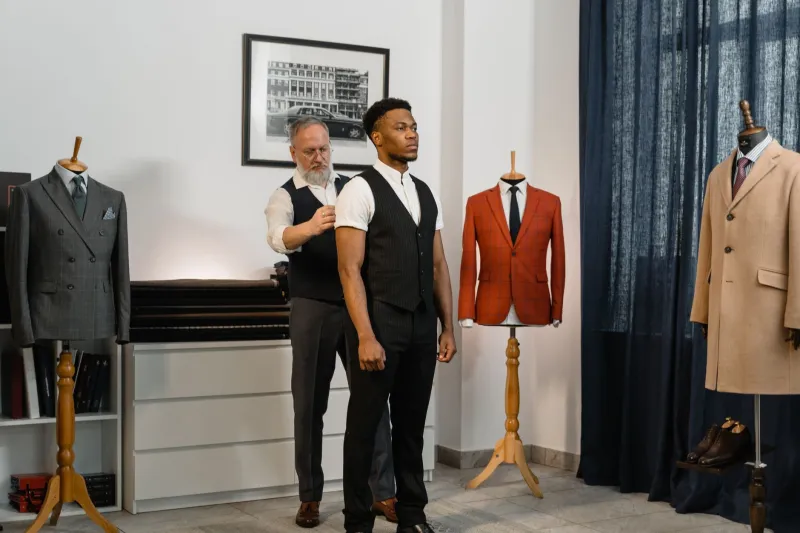
The quality of alteration work varies considerably, and identifying a skilled practitioner requires some discernment. In most American cities, independent tailors operating small shops tend to offer more attentive work than dry cleaners who provide alterations as a secondary service. Look for someone who asks questions before picking up a pin — a good tailor wants to understand how you move, how you wear a garment, and what you expect from the finished result.
Recommendations from trusted sources carry more weight than online reviews in this category. If you know someone whose clothing consistently fits well, ask where they have their work done. Tailors who serve a loyal clientele over many years have earned that loyalty through consistent results.
When evaluating a new tailor, start with a straightforward job: a hem, a waist suppression, a sleeve adjustment. Examine the finished work carefully. Are the stitches even and unobtrusive? Does the seam lie flat without puckering? Is the silhouette clean from multiple angles? A tailor who handles simple work with precision is likely to handle more complex alterations with the same care.
Which Garments Are Worth the Investment
Not every piece in your closet is a candidate for tailoring, and part of spending wisely is knowing the difference between a garment worth correcting and one that has reached the end of its useful life.
The strongest candidates for alteration share a few characteristics. They are made from quality materials — natural fibers or durable blends — with construction that can withstand the process. They have adequate seam allowances, meaning there is enough fabric at the seams to permit letting out as well as taking in. And they are garments you would wear consistently if the fit were resolved.
Structured pieces — wool blazers, tailored trousers, overcoats — typically offer the most return on alteration investment. These garments are expensive to replace well, respond predictably to skilled adjustment, and occupy a central role in most wardrobes.
Conversely, some garments are not worth the cost of correction. Heavily worn pieces with compromised fabric integrity will not be meaningfully extended by alteration. Garments with minimal seam allowances — common in fast-fashion construction — may not physically accommodate the adjustments needed. And pieces with complex pattern matching at the seams, such as plaids or stripes, require additional skill and time that may not be economically justified.
A candid tailor will tell you when a garment is not worth the work. That honesty is itself a sign of someone worth returning to.
Building Tailoring Into Your Wardrobe Practice
The most effective approach to tailoring is not reactive but anticipatory. Rather than waiting until a garment is worn and disappointing, evaluate fit at the point of purchase with alteration in mind. A jacket that fits well through the shoulders but carries excess at the waist is a strong candidate — shoulder alterations are complex and expensive, while waist suppression is straightforward. A dress shirt with the right collar and chest measurement but an overly long body is easily corrected.
When shopping for quality pieces, ask yourself not only whether the garment fits now, but whether it can be made to fit precisely. This reframes the purchase decision in a useful way: you are not buying a finished product so much as a material foundation that a tailor will help you complete.
Over time, this practice compounds. A wardrobe assembled with tailoring in mind — each piece adjusted to your proportions, each seam carrying the right tension, each hem sitting at the right point — functions differently than one assembled by hope and approximation. Garments last longer. They are worn more often. They require replacement less frequently.
At Steadfast Apparel, we hold that durability is not simply a property of fabric or construction. It is also a function of fit. A garment that conforms to your body is a garment that will serve you well — and a tailor who understands your proportions is one of the most practical allies a thoughtful dresser can have.