The Resale Advantage: How Pre-Owned Quality Clothing Beats Fast Fashion at Its Own Game
The conventional logic of clothing economics runs something like this: buying new is safer, more reliable, and worth the premium over secondhand. The item arrives in pristine condition, with tags intact and no history of wear. It feels like a sound investment.
For garments produced by manufacturers who prioritize quality, that logic has some merit. For the fast fashion category — which now accounts for a substantial share of retail clothing sold in the United States — it collapses almost immediately under scrutiny. A new garment from a brand that builds to a price point rather than a standard of durability is not a reliable purchase. It is a temporary one. And the alternative, increasingly recognized by thoughtful consumers, is the secondhand market for brands that were built differently.
Why Older Clothes From Quality Brands Outlast Newer Fast Fashion
The resale market is not a uniform category. A pre-owned garment from a heritage workwear brand or a mid-century American manufacturer occupies an entirely different tier than a lightly used piece from a contemporary fast-fashion retailer. The distinction begins with how each was made.
Manufacturers operating before the widespread offshoring of textile production — and those who have maintained rigorous quality standards despite industry-wide cost pressures — typically built their garments with heavier fabric weights, reinforced stress points, and construction techniques that assumed the clothing would be worn and washed repeatedly over years, not months. Seam allowances were generous. Stitching was dense. Hardware was functional rather than decorative.
By contrast, fast fashion production is optimized for low unit cost and high turnover. Fabric weights are minimized. Seams are sewn to hold through the initial wearing, not through sustained use. The business model depends on the garment's relatively rapid obsolescence.
The practical result is that a well-maintained oxford shirt from a reputable American manufacturer produced in the 1980s or 1990s may offer more remaining useful life than a new shirt purchased from a fast-fashion retailer today — and it will frequently cost less.
Understanding the Resale Market for Durable Apparel
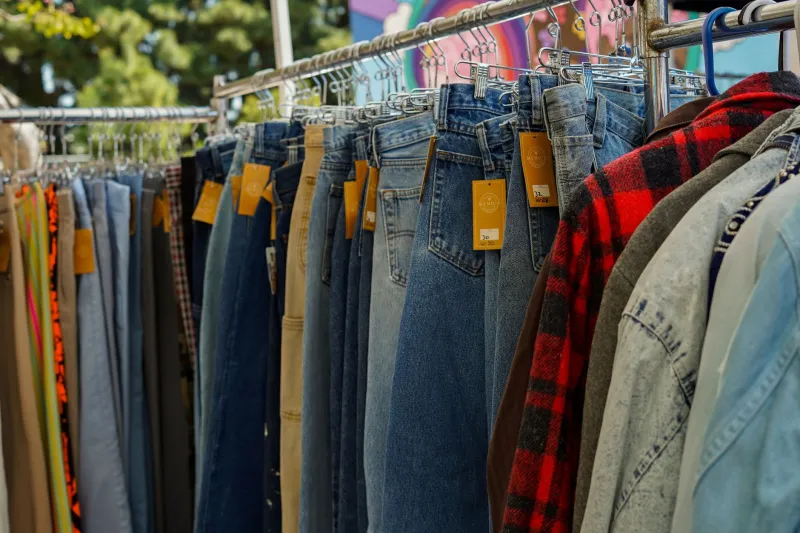
The American secondhand market has matured considerably over the past decade. Platforms including ThredUp, Poshmark, eBay, and The RealReal have made quality pre-owned clothing accessible to buyers nationwide, while traditional thrift stores operated by Goodwill, Salvation Army, and independent nonprofits remain productive sources for those willing to invest time in browsing.
For quality-focused shoppers, certain categories and brands reward consistent attention. Heritage American workwear labels — Carhartt, Red Wing, Filson, and Levi's among them — hold up exceptionally well through years of use and are widely available in the resale market at prices well below retail. Classic American sportswear brands from the mid-twentieth century, when domestic manufacturing standards were at their peak, represent another productive category. Wool overcoats, leather goods, and tailored clothing from established American and European manufacturers also appear regularly in resale channels at prices that reflect their age rather than their remaining quality.
Navigating Vintage Sizing with Confidence
One practical challenge that deters some buyers from the vintage and secondhand market is sizing inconsistency. American sizing conventions have shifted meaningfully over the decades, and a garment labeled as a size 14 in a 1970s catalog represents different actual measurements than a contemporary size 14.
The solution is straightforward: purchase based on measurements rather than labels. Before shopping secondhand, take your own measurements — chest, waist, hips, inseam, and sleeve length at minimum — and keep them accessible when browsing. Most reputable resale platforms either provide seller-listed measurements or allow buyers to request them. For in-person thrifting, a soft measuring tape is a practical addition to any shopping trip.
Vintage garments also tend to be cut with less stretch and more ease than contemporary clothing. A structured vintage blazer may require slightly different proportions than a modern equivalent, and accounting for this in your measurements will prevent sizing errors.
Recognizing Brands With Genuine Craftsmanship Legacies
Not every older brand represents a quality legacy worth seeking out. Researching the manufacturing history of a label before committing to a purchase is time well spent. Several indicators are worth noting.
Brands that maintained domestic production in the United States through the 1990s or beyond, or that operate their own manufacturing facilities rather than outsourcing entirely, generally represent more consistent construction standards. Labels that have maintained a reputation for specific craft categories — Pendleton for wool, Wrangler and Levi's for denim, LL Bean for outerwear, Brooks Brothers for tailoring — often live up to that reputation in their older pieces, even if more recent production has shifted toward lower standards.
Online communities dedicated to heritage clothing, workwear, and vintage American apparel — found on platforms including Reddit, dedicated forums, and specialty blogs — offer remarkably detailed knowledge about specific brands, manufacturing eras, and construction markers. Consulting these resources before making a significant resale purchase can prevent costly errors and point buyers toward genuinely exceptional pieces.
The Economics of the Pre-Owned Quality Purchase
Consider a straightforward comparison. A new pair of chino trousers from a fast-fashion retailer may retail for $35 to $50. At that price point, the fabric weight is likely minimal, the construction is optimized for cost, and a realistic useful life — before pilling, seam failure, or fabric thinning renders them unwearable — may be 12 to 18 months of regular use.
A comparable pair of chinos from a quality American manufacturer, purchased through a resale platform in good condition, might cost $20 to $45 depending on the brand and condition. The fabric is heavier, the construction more durable, and the remaining useful life — even accounting for prior wear — may extend several years further. Over a five-year horizon, the secondhand purchase delivers substantially more value per dollar spent.
This arithmetic applies across virtually every clothing category. It becomes even more pronounced in higher-investment items such as wool coats, leather footwear, and tailored jackets, where quality construction is most directly reflected in longevity and where the resale discount is often steepest relative to original retail price.
Positioning Resale as a Values-Aligned Strategy
Beyond the economics, purchasing pre-owned quality clothing is consistent with a broader set of values that Steadfast Apparel's readers tend to hold. It extends the useful life of garments that already exist, reducing demand for new production. It rewards manufacturers who built things to last by sustaining the market for their work. And it builds a wardrobe grounded in genuine quality rather than in the temporary appeal of the new.
The secondhand market is not a compromise. For the informed buyer, it is frequently the most intelligent path toward a wardrobe that is both economically sound and built to endure.