Beyond the Hem: Why Skilled Alterations Are the Most Undervalued Investment in Fashion
There is a persistent misconception in American fashion culture that alterations are reserved for special occasions—a wedding dress taken in, a suit jacket lengthened for a graduation. Outside of those ceremonial contexts, the prevailing assumption is that clothing should fit when you buy it, and if it doesn't, the answer is to buy something else.
This assumption is both economically costly and environmentally consequential. It treats the human body as a standard variable and manufactured clothing as the fixed point, when the reality is precisely the opposite. Bodies change. Tastes evolve. Proportions shift. A garment that does not account for these realities is not a wardrobe investment—it is a temporary placeholder.
Skilled alterations invert this logic. They make the garment serve the person, rather than the reverse. And when approached with intention, they represent one of the most durable, cost-effective, and ethically sound decisions an intentional dresser can make.
The Scope of What Alterations Can Actually Do
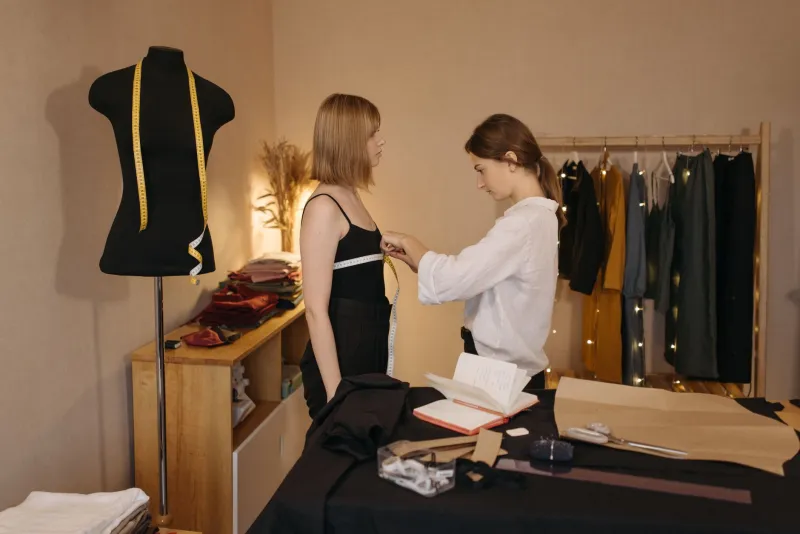
Many people underestimate the range of transformations available through skilled tailoring. Hemming a pair of trousers is the entry point, not the ceiling. A competent tailor can accomplish considerably more.
Silhouette reconstruction is among the most powerful applications. Blazers and structured jackets from previous decades often carry proportions—extended shoulder lines, boxy torsos, exaggerated lapels—that feel dated by contemporary standards. A skilled tailor can suppress the waist, narrow the shoulders, and reshape the chest to produce a silhouette that reads as current without sacrificing the underlying quality of the original garment. The result is a piece that carries the construction integrity of an earlier era of manufacturing while presenting with modern relevance.
Accommodating body changes is equally important, and far less discussed than it should be. Bodies change across a lifetime—through weight fluctuation, pregnancy, aging, and fitness. A well-made garment that no longer fits is not a failure; it is simply a garment awaiting adjustment. Letting out a seam, restructuring a waistband, or adjusting a dart can return a beloved piece to active rotation without the financial and environmental cost of replacement.
Thrifted and secondhand pieces represent perhaps the most compelling case for alteration investment. Quality garments from estate sales, consignment shops, and online resale platforms often carry exceptional construction at a fraction of their original price—but they arrive in sizes and proportions that reflect someone else's body. A modest alteration budget applied to a well-sourced secondhand piece can produce a custom-quality result at a cost that no new garment at a comparable price point could match.
The Economics: What Alterations Actually Cost Versus What They Return
The perception that alterations are expensive is worth examining carefully, because it rarely holds up against the numbers.
Consider a wool blazer purchased secondhand for $45 that requires waist suppression and sleeve shortening. A competent tailor in most American cities will perform both alterations for between $60 and $90. The total investment is approximately $135 for a garment that, new, would cost several hundred dollars—and which now fits with precision. That is not a frivolous expenditure. It is arbitrage.
Apply the same logic to a dress shirt that fits well through the shoulders but is too full through the body—a common problem with off-the-rack sizing. A side seam taper costs between $20 and $40 at most tailors. The shirt, which was functional but slightly sloppy before, becomes sharp and intentional after. The cost per wear over the shirt's remaining life is negligible.
The comparison that matters is not alterations versus doing nothing. It is alterations versus replacement. When the alternative is purchasing a new garment—one that may itself require alteration, may not be as well constructed, and will certainly carry a higher price—the economics of skilled tailoring become difficult to dispute.
Finding the Right Tailor: A Practical Framework
The quality of an alteration depends almost entirely on the skill of the person performing it. This is not a category where the cheapest option and the best option are interchangeable.
Seek out tailors who specialize in garment construction rather than dry cleaning add-ons. A tailor whose primary business is alterations and bespoke work will typically have a finer command of fit, proportion, and fabric behavior than one who offers alterations as a secondary service. Ask to see examples of previous work, particularly on structured garments like jackets and trousers. Examine the stitching, the pressing, and the overall silhouette of finished pieces.
Before committing to significant structural work, begin with a smaller alteration to evaluate the tailor's judgment and communication. A good tailor does not simply execute instructions—they ask questions, identify potential complications, and advise honestly about what is and is not possible given the garment's construction.
Alteration Literacy as a Dressing Skill
Perhaps the most important shift this article advocates is conceptual: treating alteration literacy as a core competency of intentional dressing rather than a specialized or occasional recourse.
Alteration literacy means understanding, before you purchase, which adjustments are straightforward and which are structurally complex. It means knowing that taking in a side seam is simple while moving a shoulder seam is expensive and technically demanding. It means recognizing that a jacket with genuine bone structure—canvas interlining, well-set sleeves—will reward alteration investment in ways that a fused, glued construction will not.
This knowledge changes how you shop. A garment that fits well through the shoulders but needs waist suppression becomes a confident purchase rather than a hesitant one. A secondhand coat that is slightly long becomes an opportunity rather than an obstacle. You begin to see not only the garment as it is, but the garment as it could be—and that expanded perspective is the foundation of a wardrobe that is genuinely built to last.